



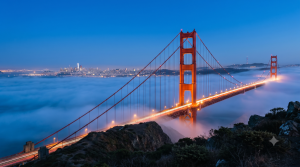
SAN FRANCISCO — As the morning fog rolls lazily through the strait, a colossal, fiery-orange silhouette begins to pierce the gray shroud. It is a sight that has captivated travelers, artists, and engineers for nearly a century. Often searched by global tourists simply as the “Golden Bridge,” the Golden Gate Bridge remains more than just a transit route; it is the definitive heartbeat of San Francisco and a triumph of human ambition.
While it is no longer the longest suspension bridge in the world, it arguably remains the most famous. But what is it about this Art Deco masterpiece that continues to command the global imagination?
What’s in a Name? Dispersing the “Golden” Myth
To understand the bridge, one must first understand its name. It does not look golden, nor was it built during the gold rush. The structure takes its name from the Golden Gate Strait—the narrow, turbulent three-mile channel connecting the San Francisco Bay to the Pacific Ocean.
Topographical engineer John C. Frémont named the strait in 1846, evoking the Golden Horn of Constantinople. When plans for the bridge materialized in the 1930s, the name stuck, even if it occasionally confuses first-time visitors expecting a gilded highway.
A Depression-Era Miracle
When chief engineer Joseph Strauss proposed bridging the treacherous strait in the 1920s, critics scoffed. The project faced a seemingly insurmountable trifecta of obstacles: relentless 60-mph winds, a choking marine fog that blinded workers, and strong ocean currents. Furthermore, the Wall Street Crash of 1929 meant funding was practically non-existent.
Yet, against all odds, construction began in 1933. Strauss prioritized safety in an era when construction fatalities were treated as routine. He famously installed a revolutionary safety net beneath the span, which saved the lives of 19 men. These survivors proudly formed the “Halfway to Hell Club.”
When the bridge opened in 1937, it defied the gloom of the Great Depression, standing as a monument to American resilience and industrial might.
The Accidentally Iconic “International Orange”
Perhaps the bridge’s most defining feature is its color, yet its iconic hue was entirely accidental.
The steel arrived in San Francisco coated in a reddish-orange primer. While the U.S. Navy aggressively lobbied for the bridge to be painted in yellow and black stripes to ensure visibility for passing ships, consulting architect Irving Morrow had a different vision. He noticed how the warm primer contrasted beautifully with the cool blues of the ocean and the golden-brown of the California hills.
Morrow formulated the custom blend we see today: International Orange.
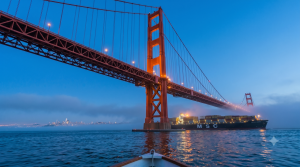
“The effect of International Orange is as variable as the California weather,” Morrow once noted. “It can appear brilliantly fiery in the midday sun, or look almost ethereal, dissolving into the evening fog.”
The Living Monument: A Modern Visitor’s Perspective
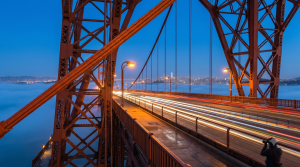
Today, the Golden Gate Bridge is not just a relic of the past; it is a living, breathing piece of infrastructure. Crossing it—whether by car, bicycle, or on foot—is a sensory experience.
- The Sound: Pedestrians are often startled by the bridge’s “voice”—a low, haunting hum created by high winds passing through its newly redesigned, aerodynamic sidewalk railings.
- The Movement: The bridge is engineered to be flexible. On a windy day, visitors can actually feel the deck sway up to 27 feet laterally and 10 feet vertically.
- The Workforce: A dedicated crew of ironworkers and painters scales the heights daily. Contrary to the urban myth that the bridge is painted from end-to-end in a never-ending loop, the team actually targets specific areas based on where the salty Pacific air causes the most corrosion.
Where to Witness the Magic
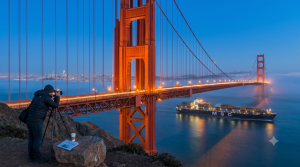
For journalists and photographers looking to capture the definitive shot of the span, timing and location are everything.
- For the Drama: Battery Spencer, located on the Marin County side, offers the classic cliffside perspective where the bridge looms large against the San Francisco skyline.
- For the Scale: Marshall’s Beach provides a rugged, sea-level view where the crashing waves of the Pacific frame the towering south anchor.
- For the Atmosphere: A late afternoon visit during the summer months almost guarantees an encounter with “Karl the Fog,” the city’s famous microclimate phenomenon that wraps the bridge in a dramatic, cinematic blanket.
Nearly nine decades after its completion, the Golden Gate Bridge refuses to blend into the background. It stands as a testament to the idea that infrastructure can be poetic, and that a blend of steel and orange paint can come to define the spirit of an entire city.